

By Rob Thorn
On December 14, 75 observers sponsored by CAS spent the day counting birds in different areas of Columbus. In a switch from the last 2 years, the day wound up being clear, but the coldest day of the year, with 5 inches of snow on the ground as well. 18 teams were able to gather 78 species and 15,642 individuals: a surprisingly average Count given the weather.
Count Date: December 14, 2025; 6:00 am to 5:00 pm. Temp. 4 – 16 ºF. Wind: WNW 2-4 mph. Still water mostly frozen; moving water open. AM. clear, frigid; PM. the same. Observers: in the field in 6-19 parties, 3 at feeders part of day. Total party hours: 104 (94 on foot, 10 in cars). Total Party miles: 226 (122 on foot, 104 in cars); owling: 2 hours, 8 miles
Species: Double-crested Cormorant – 2; American White Pelican – 4 (flyover flock, KK) Great Blue Heron –38 ; Mute Swan – 6; Trumpeter Swan – 6 (BM et al.); Canada Goose – 2147; Cackling Goose – 6 (BM et al.); Black Duck –41 ; Mallard –1050 ; Green-winged Teal – 1 (SB,TW); Gadwall – 29; American Wigeon –8; Ring-necked Duck –67 ; Greater Scaup – 1; Bufflehead – 1; Hooded Merganser –106 ; Ruddy Duck –3; Wild Turkey – 4; Sandhill Crane – 34 (flyover flock, KK), Black Vulture – 2 (2 teams); Sharp-shinned Hawk –4 ; Cooper’s Hawk – 10; Northern Harrier – 2; Red-shouldered Hawk –6 ; Red-tailed Hawk – 19; Bald Eagle – 17; Peregrine – 1, Merlin – 3; American Kestrel –3 ; Killdeer – 5 ( 3 different teams); Bonaparte’s Gull – 2; Ring-billed Gull –525 ; Herring Gull – 3; Rock Dove – 223; Mourning Dove – 135; Great Horned Owl – 3; Barred Owl –1 ; E.Screech Owl – 1 (JK) ; Belted Kingfisher – 14; Red-headed Woodpecker – 4; Red-bellied Woodpecker – 121; Yellow-bellied Sapsucker –26 ; Downy Woodpecker –160 ; Hairy Woodpecker – 14; N.Flicker –29 ; Pileated Woodpecker – 11; Blue Jay –210 ; American Crow –277; Horned Lark – 53; Carolina Chickadee –159 ; Tufted Titmouse – 89; White-breasted Nuthatch –83 ; Red-breasted Nuthatch – 4; Brown Creeper –24 ; Winter Wren – 3; Carolina Wren –84 ; Ruby-crowned Kinglet – 4; Golden-crowned Kinglet –9 ; Eastern Bluebird –85 ; Hermit Thrush – 10; American Robin – 1325; N.Mockingbird – 1; European Starling – 5256; Yellow-rumped Warbler –20 ; Northern Cardinal –530 ; Eastern Towhee –10 ; American Tree Sparrow –37; Fox Sparrow –5(4 different teams); Song Sparrow –120; Swamp Sparrow –5 ; White-throated Sparrow –400 ; White-crowned Sparrow –2 ; Dark-eyed Junco –598 ; Dark-eyed Junco (Oregon X Slate-colored) – 1 (PG); Red-winged Blackbird –58 ; Common Grackle – 20; Brown-headed Cowbird –68 ; House Finch –377 ; American Goldfinch –201; Pine Siskin – 26; House Sparrow –578
Totals: 78 species, 15,642 individuals
Birds seen Count Period, but not Count Day: Northern Shoveler, Lesser Scaup, Redhead, Gray Catbird, Brown Thrasher, Cedar Waxwing, Purple Finch
Observers: Julie Aldridge, Anne Baird, Wendy Becker, Linda Benner, Cody Berkebile, Susan Braunig, Marcia Brehmer, Gerry & John Brevoort, Matt Bystrom, Maya Corridore, Mary Counter, Brad, Lindsay, & Poppy Deering, Amy Densborn, Matt DeTemple, Steve Draeger, John & Kristan Finn, Diana Fowler, Brad Gambill, Paul Graham, Elizabeth Hamilton, James Holsinger, Marshall Johnson, Peter Kaestner, Wendy King, M. K. Klenkar, Jonathan Knape, Kristi Krumlauf, John Kuenzli, Donna Kuhn, Noelle Lenhart, Bruce & Helen Lindsay, Shellie & Sandie Lloyd, Cheryl Lubow, Ernest Manke, Laura Mansfield, Karen & Frank Martens, Bernie & Susan Master, Sue Mathews, Fiona McCarthy, Stacey & Darrell McGrath, Mitch McGreal, Joe Meara, Karl Mechem, Bruce & Kelly Miller, Dick Miller, John Mittermeier, Sharon Newell, Dai Newman, Brian O’Connor, Lori Patterson, Pam Raver, Robert Royse, Andy Schneider, Irina Shulgina, Darlene Sillick, Shaune Skinner, Brent Sohnsen, Leslie Sours, Andy Spector, Mark Swetstad, Rob Thorn (compiler), Nick Wayne, Alan Weinberg, Carl Winstead, Tracy Wiczer, Dan Iven, Julie Iven, and Bill Heck.
Description: After 2 years where heavy rain pelted counters, our constant prayer was, “Please don’t let it rain. Please don’t let it rain.” I guess we should have been a bit more specific in our request. It’s good to see that God has a sense of humor, though, as we were gifted with 5 inches of snow and subfreezing temperatures. Despite all that, legions of dedicated (and slightly crazy) birders got out for part or all of the day to dig birds out in the frigid conditions. The species total was down a bit, but was close to our 30-year average. The total numbers were low, mostly due to reduced birding hours. However, if you calculate birds-per-hour, it was comparable to the past 10 years, bad weather and good.
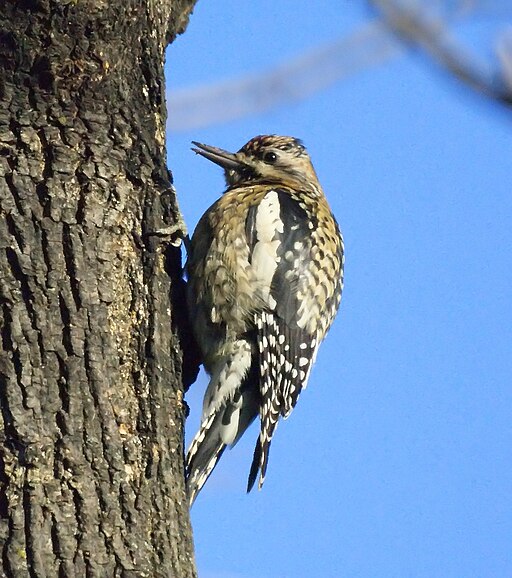
If you wanted to encapsulate this CBC in a few words, they would be ‘frigid’ and ‘sapsuckers’. The morning temperature was a brisk 4 degrees, and we have to give shout-outs to several teams that not only survived the cold blast, but pushed right through it. The 3-Creeks teams (John Kuenzli, Brad & Lindsay Deering) who knew they would be in exposed habitats, still covered their areas with surprising thoroughness. Similarly, Leslie Sours braved the tundra of Waterman Farms, Linda Benner & Lori Patterson skated along the Blacklick Greenway, and Jon Knape & Brad Gambill hustled through multiple sites in Blendon Township. The Scioto Audubon team led by John & Kristan Finn covered their huge territory, even though the river was frozen and most of the birds had fled to feeders and milder pockets in other areas. Really, anyone who got out in the brutal morning wind deserves our thanks, and maybe counseling. As for the sapsuckers, they were everywhere. We set a Count record with 26. Often teams found more than 1; Carl Winstead found 4 in the Grandview area alone. It’s clear they don’t particularly mind cold weather.
So how did this Count stack up? Waterfowl were a tricky feature of this CBC, given the many frozen bodies of water. Dabbling ducks were just OK, with Wigeon and Green-winged Teal present, but no Shovelers. Diving Ducks were a bit low, with Greater Scaup, Bufflehead, and Ruddy Ducks as the stars, but Redheads and Lesser Scaup were only in Count Week. Canada Geese seemed unaffected by the cold, and Bernie Master’s team gathered up 6 Cackling Geese in the quarry lakes off Haul Road. They also scored both Mute & Trumpeter Swans there.
Fish-hunters were definitely down, with limited open water. Hooded Merganser numbers were low, with barely over 100 birds, and Pied-billed Grebes were a no-show for the first time in many years. We couldn’t even find them in Count Week. We found only 2 cormorants, but a high-flying group of 4 White Pelicans was seen over Jefferson Township by Kristi Krumlauf – probably headed for the Gulf Coast (the pelicans, not Kristi). The 38 Great Blue Herons was low, similar to the 37 found in the rainy CBC of 2023. Belted Kingfishers were also conspicuously scarce.
Raptors had a mixed year, which was a bit unexpected since cold usually makes them more noticeable. Our Bald Eagles dropped from last year’s exceptional 30 to a mere 17. Accipiters and Buteos dipped in the cold, with 39 individuals (vs. 65, 64, and 50 the past 3 years); perhaps we are getting too urban for their liking. Falcons were OK, with the OSU Peregrine putting in an appearance for Irina Shulgina & Matt Bystrom. 3 Merlins and 3 Kestrels rounded out the falcons. Our most unexpected raptors were Northern Harriers: 2 were at Waterman Farm (Leslie Sours), while another was down in southern 3 Creeks (John Kuenzli). John also hustled up a Screech Owl from the creek bottoms of 3-Creeks. Also unexpected were Black Vultures pulled out by 2 teams: Blendon Woods (James Holsinger) and Blacklick Greenway (Linda Benner & Lori Patterson).
Fruit-eaters were way down this year, as the repeated cold snaps caused them to eat through the available berries quickly. Starlings, Robins, and Bluebirds all showed significant declines, while we had only 1 Mockingbird and missed out on Cedar Waxwings completely. Only Hermit Thrushes, which focus on wintercreeper berries now, seemed to hold their numbers.
Field birds were rather poor, as has been the pattern on recent Counts. Killdeer were a bright spot, with the snow forcing 5 individuals to spots where we could find them. Another bonus was a flock of Sandhill Cranes (Kristi Krumlauf): a species that seem to migrate later and later. Horned Larks were also a rather expected bonus; snow often drives them into our circle, where plowed roads offer some forage-able edges. Unfortunately, open-country sparrows were a casualty of this same weather, as we had no Field, Chipping, or Savannah Sparrows.
Insect-eating birds showed mixed numbers, surprising given the frigid weather. Carolina Wrens were quite low, but 3 Winter Wrens was similar to other recent counts. Kinglets were mixed: 9 Golden-crowns was very low, but 4 Ruby-crowns were a Count record. Yellow-rumped warblers rebounded a bit from last winter’s dismal CBC showing, but we still had only 20 on the Count. 24 Brown Creepers was an uptick from last year’s 17 birds, but still below the 33 of 2023.
Winter irruptors had a modest impact on this year’s Count. Red-breasted Nuthatches had only 4 birds, hardly an irruptive bonanza, but 26 Pine Siskins was a good total, all from the Greenlawn cemetery feeders. No Purple Finch was on the Count, but 1 was in west Columbus a few days before. Tree Sparrows – another cyclical winter bird – had a slow year, with only 37 birds, down from 51 in 2024 and 78 in 2023.
So what did this extremely cold CBC tell us? We’ve had them before: since 1969, eight Counts have had low temperatures in the single digits. Only 1 of them had higher than 80 species, and all had total individuals less than 22,000. Several Counts (1977, 1983, 1989) actually had worse cold than this CBC, and had similar species and total numbers. Only a few species (Carolina Wrens, Eastern Bluebirds, Mockingbirds) seemed to lose numbers for multiple years following very cold winters. So our environs seem varied enough to keep many birds alive during severe cold snaps. In fact, our lower numbers on cold counts seems to be more due to observer fatigue than bird absence. If you’re not prepared for it, very cold weather saps your energy.
A far more worrisome problem is peoples’ increasing disconnection from nature. Columbus is running through its third major building boom, and unprotected land is being quickly developed into apartments or dense housing tracts. Fewer greenspaces, fewer feeders, fewer birds all leads to fewer person-bird interactions. That’s something to worry about, especially as many people now view wildlife through the remove of their digital devices. Our Counters probably had more bird encounters, even on a frozen morning, than 99% of Columbus residents have on a nice winter day. I want to think that CBCs, eBird, Merlin, and field trips can help reverse this trend, but we clearly have our work cut out for us.