
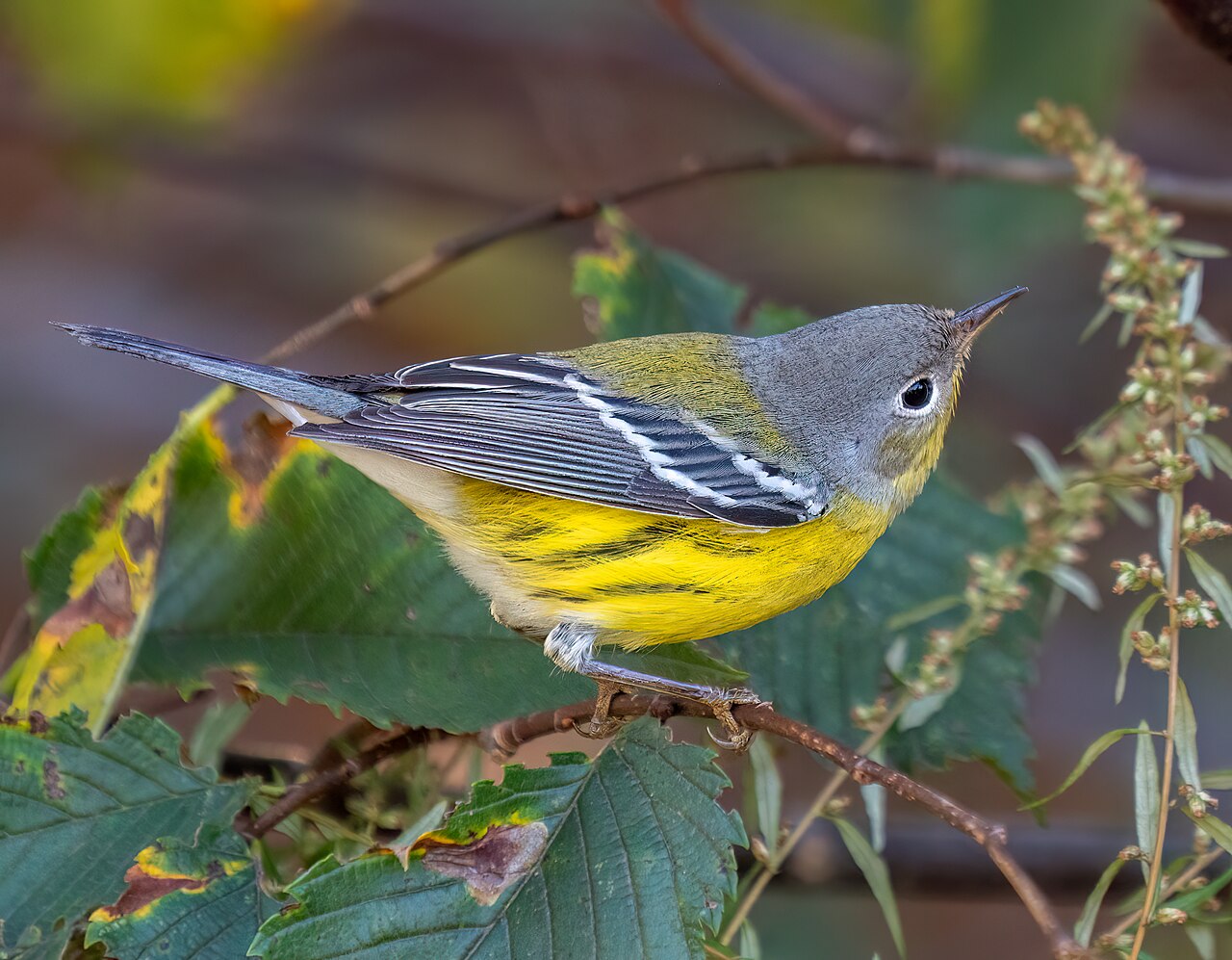
Featured Image Photo Credit: Rhododendrite
It was my first fall migration birdwalk in Ohio, and I was curious as to what migrants would show up here in the Midwest. One of the first we spotted, darting around a low bush, tail flicking open, was a Magnolia Warbler. I was entranced; they were unknown in Washington state where I had spent the prior 15 years, and were very rare in south Florida where I grew up. “Are they always this animated and colorful”, I asked Jim, our leader., “I was expecting fall warblers to be dull and furtive.” “Oh yes, and they’re not particularly rare or shy,” he replied with a smile. Within minutes we had spotted three more and would go on to find double-digits in two hours that morning.
“Magnolia” is a bit of a misnomer. While they may feed in magnolia trees on migration (that’s where the first specimen was collected), a better name might be “Black-streaked Lemon-breasted Spruce Warbler”. They breed almost entirely in spruce and hemlock areas of boreal forests, mostly in Canada, but including some areas of northern Minnesota, Wisconsin, Michigan, and New York, even extending south in the higher parts of the Appalachians. We even have a few breeding in Ohio, in the far northeast corner, with occasional breeding in the Mohican and Hocking Hills areas. Most of us, however, will see our Magnolia Warblers during migration.
Magnolia Warblers are one of our most common and easily-spotted migrant warblers. Even the young fall birds have a bunch of field marks that help distinguish them from other yellowish warblers. They all seem to have some thick streaking on the flanks of a lemon-yellow chest, starting in a gray or black necklace under the yellow throat. The lemon-yellow is unlike other warblers’ shades of yellow, and after a little practice, you can almost call the bird by this color alone. But they also usually have a grayish cap and small or partial eye-ring, as well as pronounced wing bars. The clincher mark is the tail: on the underside, it’s black towards the tip, and white towards the base. Even fall birds usually have these core marks – lemony yellow breast, gray necklace, black & white tail underside – which are highlighted in this video: https://www.youtube.com/watch?v=ru3IJuC91Bg .
In springtime, mature birds have much more vibrant colors – their breast is brighter, the necklace and breast streaks are jet black, and the head has a black mask and white eyebrow contrasting with the gray crown. The wing bars are enlarged to form noticeable white panels on their wings. They still have the two-toned tail, and it’s often flexed and sometimes flared to reveal white tail bars, somewhat similar to the yellow tail bars on a female Redstart. This video of singing males showcases these field marks and almost takes your breath away: https://www.youtube.com/watch?v=2Vth2XSAAxM .
Like Redstarts, behavior is also a fairly good mark for these warblers. They tend to forage lower than most other warblers, often in bushes and low trees, and favor the edges and tips of branches. They‘re also quite active, darting and hovering around these areas, often flaring their tails. Indeed, they can be tough to follow as they move around, but fortunately their many field marks can often clinch an ID with the briefest of looks. Unlike most other migrant warblers, which tend to retire after morning feeding, Magnolias can be active late into the morning and early afternoon, another trait they share with Redstarts.
While other warblers have struggled to maintain decent numbers, “Maggies” have seemed to hold steady, if not increase. In fact, bird counts have noted that this is one of the few warblers that has increased its numbers steadily over the past decades. Along with Redstarts and Bay-breasteds, this has become one of our most common fall migrant warblers, so it’s good to learn their field marks so you can quickly pick them out. Why have they become so common? Probably a combination of factors. Canadian spruce forests have been fairly stable, and logging has produced lots of young stands that are often caterpillar-infested, which helps several species, including Magnolias and Bay-breasteds. Also, their feeding strategy, where they often use their tail flaring to startle prey insects into movement, seems to allow them more feeding opportunities and greater success across different microhabitats. Some of these ideas have helped shape conservation plans for Magnolia Warblers in other parts of the Midwest (WI: http://www.wisconsinbirds.org/plan/species/mawa.htm , MN: https://mnbirdatlas.org/species/magnolia-warbler/
Where can you find Magnolias easily on migration? Like most warblers, they migrate at night, and come down to forest areas in the morning hungry for insects. Look for them in the morning on the sunny edges of forest blocks anywhere in central Ohio. Forested parks with exposed east-facing edges are best. Some of the most reliable spots for them have been the Goldenrod Trail at Blendon Woods, the Trail of the Ancients at Battelle Darby MetroPark, the Multi-use Trail loop at Blacklick Woods, the Scenic River Trail and Coyote Run Trail at Highbanks Metro Park, and the Great Horned Owl Trail at Shale Hollow Park. Truth be told, these spots are great for all kinds of warblers. It’s just that Magnolias will be among the more common and easy-to-ID warblers at all of them.